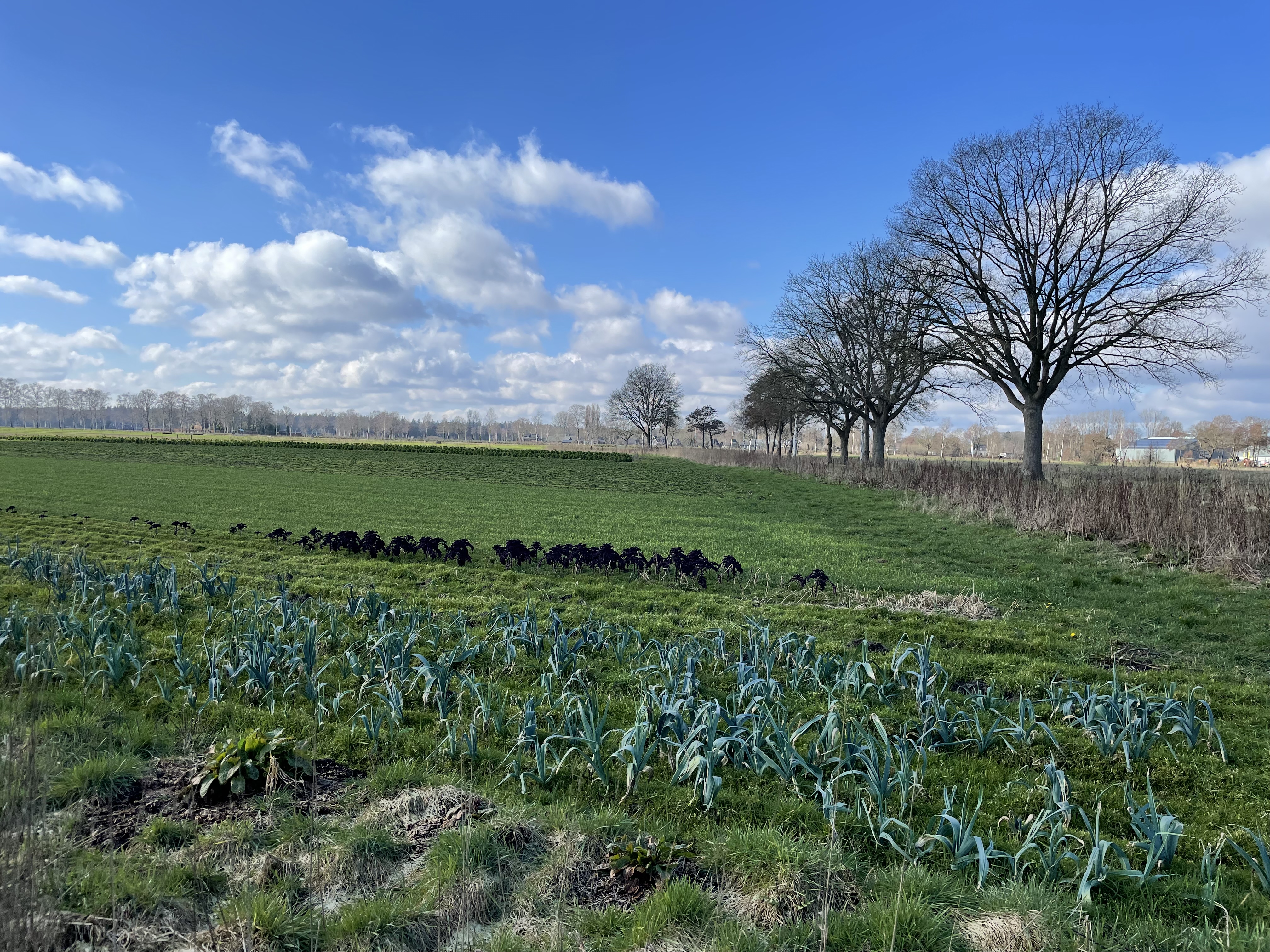
Also this year, drought is already progressing before April 1! Liduin Bos-Burgering is measuring the effects at farm site Herenboeren Nederland Wenumseveld (Apeldoorn).


Also this year, drought is already progressing before April 1! Liduin Bos-Burgering is measuring the effects at farm site Herenboeren Nederland Wenumseveld (Apeldoorn).
Liduin just finished her 2nd flow on her PhD-work on measuring evaporation on an agricultural side. This time she explains how an eddy covariance system works and a scintillometer.
Liduin just started as a PhD-candidate in our group. Currently, she is setting up her field site at farmsite Herenboeren Wenumseveld near Apeldoorn (the Netherlands). In this first vlog she clearly explains what and why she is installing DTS-cables at this farm site.
The land and the atmosphere are closely connected. From the land, water evaporates and adds moisture to the atmosphere, which in turn forms our rain. Additionally, evaporation costs energy and will lower the air temperature. Vegetation plays a major control in this interaction; however, how vegetation influences our water cycle and energy balance is poorly understood due to its dynamic behavior. Often vegetation (growth) has a season pattern (phenology), and responds in different ways to weather conditions and water shortages. Especially, in times of extremes like droughts and heatwaves, plants have very distinct survival strategies, which directly affects its water use and effects on air temperature.
My research theme focusses on better understanding the role which vegetation has on the water- and energy balance. I do this, by combining different novel sensing techniques (e.g., distributed temperature sensing, isotopic measurements) in different settings: forests, crop land, and urban land. With this I aim to answer questions like how vegetation behaves during droughts, and how e.g., extreme heat can be mitigated with adding vegetation to our living environment.
What does a musical festival have in common with #PhD @Jonathan_Izett ‘s most recent publication? #Fog, a #field, #lasers, and some #LED! Check it out: “Missed Fog” now available online in BLM. https://t.co/SpHn1I8AZg 🌫️#openaccess #science #nature #atmosphere #weather #phdlife pic.twitter.com/5RlKp1FrAf
— Geoscience TUDelft (@GRS_TUDelft) July 11, 2019
Natalie Orlowski, Matthias Sprenger, Josie Geris, Pilar Llorens, Lixin Wang, and Miriam Coenders-Gerrits
https://twitter.com/MatthiaSprenger/status/1105489269706104832
 Evaporation: the invisible water drain